
The Shoulder Wasn't the Problem: The Missing Link Behind a 12-Year-Old Baseball Player's Recurring Pain

Why some young baseball players keep hurting despite doing everything "right"

Short answer for the busy parent: If your baseball player keeps having shoulder pain despite physical therapy, stretching, rest, throwing programs, massage, acupuncture, cupping, or "just giving it time," the shoulder may not actually be the problem. One of the most overlooked causes of recurring shoulder pain in young throwers is poor force transfer through the body, especially limited thoracic spine mobility and trunk function. The shoulder often becomes the victim of a problem that started somewhere else.
As a parent, few things are more frustrating than hearing:
"His shoulder looks fine."
Because if you've watched your athlete grimace after throwing, ice their arm after games, or lose confidence because every return-to-throw attempt ends the same way, you know something isn't fine.
A few months ago, I worked with a 12-year-old baseball player from the Pittsburgh area who fit that exact description.
Smart kid.
Hard worker.
Loved baseball.
But every time throwing volume increased, his shoulder started barking.
The family had done what good parents do.
They sought help.
Physical therapy.
Stretching.
Return-to-throw progressions.
Soft tissue work.
Rest.
Even treatments like acupuncture and cupping.
Each intervention seemed to help temporarily.
Then baseball happened again.
And the pain returned.
The Question That Changed Everything
When athletes come into Earn the Edge, I'm rarely asking:
"Where does it hurt?"

I'm asking:
"Why does it hurt there?"
Those are two very different questions.
Most people begin with the painful area.
I begin with movement.
Because pain is often a clue.
Not always the culprit.
And baseball may be the ultimate example.
Throwing Is Not A Shoulder Exercise
Here's something that surprises a lot of parents:
The hardest working part of a baseball throw shouldn't be the shoulder.
The shoulder is supposed to be the messenger.
Not the muscle doing all the work.
A high-level throw starts at the ground.
The legs create force.
The hips transfer force.
The trunk amplifies force.
Then the shoulder and arm deliver that force into the baseball.
When everything works together, pitching and throwing look effortless.
When it doesn't?
The shoulder starts sending distress signals.
What We Found
The first thing that stood out wasn't his shoulder.
In fact, the shoulder wasn't particularly impressive from a problem standpoint.
Instead, we noticed something else:
His thoracic spine barely moved.
The Body Part Most Parents Have Never Heard Of
The thoracic spine is the middle portion of your back.
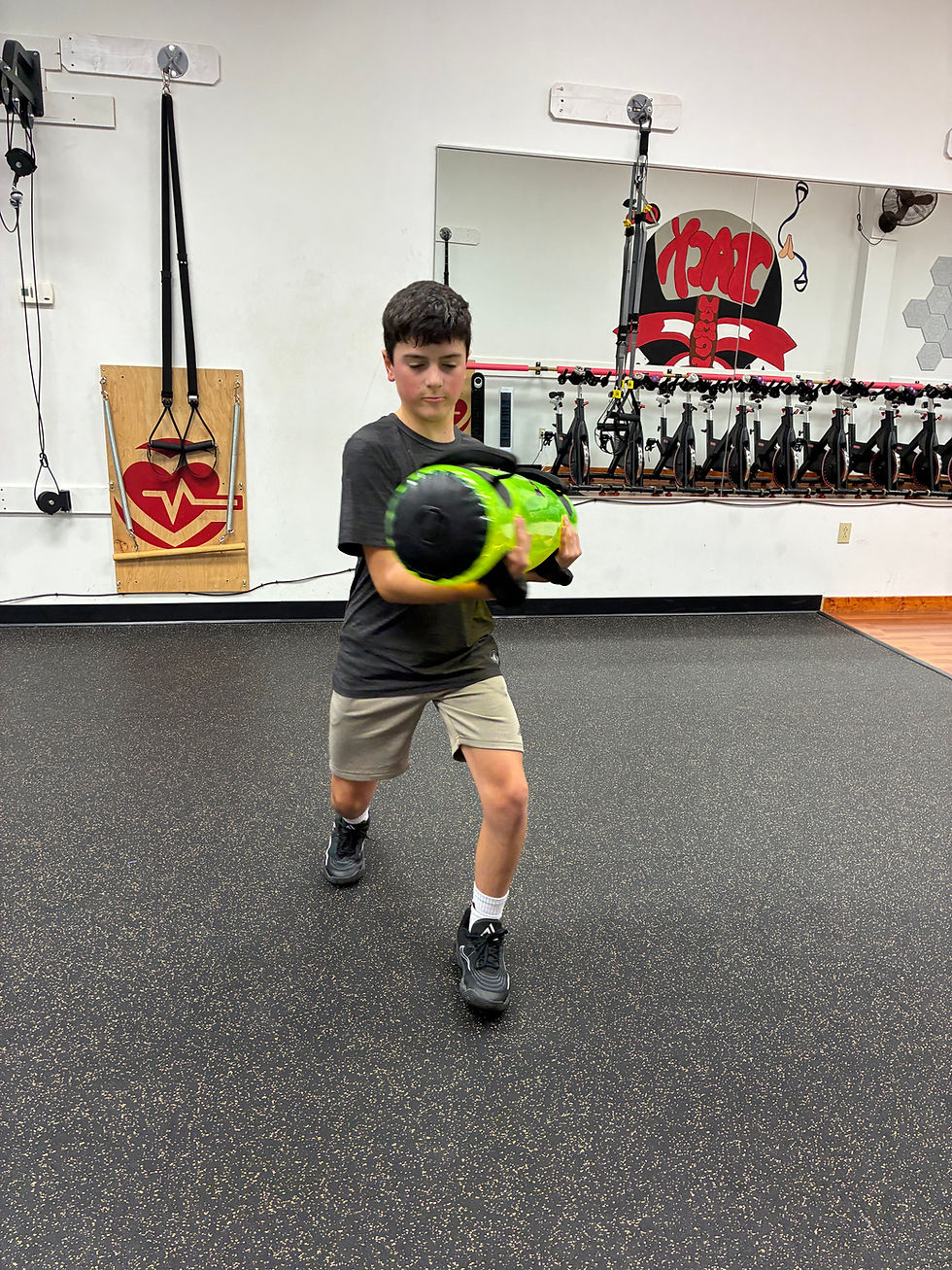
It's the area between your neck and your lower back.
It also happens to be one of the most important areas in throwing sports.
When baseball players rotate, load, separate their upper and lower body, and create velocity, the thoracic spine is a major contributor.
The problem?
Many young athletes are surprisingly stiff there.
Hours sitting in school.
Technology.
Early specialization.
Poor movement habits.
It all adds up.
Researchers and baseball performance professionals have long recognized the relationship between thoracic mobility, scapular function, and shoulder health in throwers. Shoulder Hurts? Start Here emphasizes that the thoracic spine influences multiple neighboring regions that affect shoulder mechanics, while Understanding Scapular Positioning in the Throwing Motion discusses how the thoracic region, scapula, and arm interact as part of the throwing athlete's kinetic chain. [ericcressey.com], [ericcressey.com]
For this athlete, the issue wasn't a lack of shoulder exercises.
It was a lack of contribution from the rest of his body.
Imagine Trying To Throw A Baseball With One Hand Tied Behind Your Back
That's essentially what was happening.
Every pitcher and position player needs multiple body segments contributing to the throw.
When one segment stops doing its job, somebody else gets assigned overtime.
In this case?
The shoulder was working double shifts.
The trunk wasn't producing and transferring force efficiently.
The thoracic spine wasn't rotating enough.
Energy wasn't flowing through the chain the way it should.
The shoulder was constantly trying to pick up the slack.
And eventually it complained.
Not because it was weak.
Not because it was fragile.
But because it was being asked to do a job that belonged to the entire body.
Why "More Shoulder Work" Wasn't The Answer
This is where many athletes get stuck.
They assume the painful structure is the weak structure.
Sometimes that's true.
Often it isn't.
Think about a check engine light in your car.
The light isn't the problem.
It's the warning.
If you cover the light with tape, you haven't fixed anything.
You've just hidden the message.
The same thing happens in sports medicine.
Treating only the painful area can sometimes improve symptoms.
But if nobody addresses the reason the pain developed in the first place, the problem tends to circle back around.
And that's exactly what this family had experienced.
So What Did We Do?
Nothing fancy.
No magic exercise.
No secret baseball drill.
No social-media-worthy gimmicks.
We simply improved the pieces that were missing.
We focused on:

Thoracic rotation mobility
Thoracic extension mobility
Rotational trunk strength
Trunk control
Hip mobility
Force transfer patterns
Deceleration mechanics
In other words:
We helped his body throw as a team again.
Instead of asking the shoulder to be the entire team.
The Result Parents Actually Care About
Could he throw harder?
Sure.
Performance improved.
But that's not the first thing his parents noticed.
The first thing they noticed was something much more important.
The constant cycle stopped.
No more wondering if today's practice would end with pain.
No more fear every time throwing volume increased.
No more feeling like they were one bullpen session away from restarting the entire process.
And honestly?
That might be the biggest win of all.
Is This Your Athlete?
Does your baseball player:
✅ Complain of shoulder soreness after throwing?
✅ Need more and more recovery time after tournaments?
✅ Seems fine during and after physical therapy but pain returns once baseball starts again?
✅ Keep getting told to rest, stretch, strengthen, and gradually return to throwing, only to end up right back where they started?
If so, the question may not be:
"What's wrong with the shoulder?"
It may be:
"What's forcing the shoulder to do more work than it was designed to do?"
That's the difference between symptom management and identifying the source of the problem.
Before Next Season Becomes Another Frustrating Cycle
One thing I've learned after years as an athletic trainer and sports performance specialist is that young athletes rarely break down because of a single bad throw.
Most recurring injuries happen because small movement inefficiencies accumulate thousands of times.
One missed force transfer.
One mobility restriction.
One compensation pattern.
Repeated over and over and over again.
Until pain finally gets your attention.
The good news?
Those issues are often identifiable long before they become season-altering problems.
Pittsburgh Baseball Parents: Don't Wait Until Your Athlete Can't Throw
At Earn the Edge Performance Elite Sports Performance Program, every athlete starts with a comprehensive sports medicine-based movement assessment.
We evaluate:
Thoracic mobility
Rotational strength
Force transfer mechanics
Trunk control
Hip mobility
Movement asymmetries
Throwing-related injury risk factors
Because the goal isn't simply getting rid of pain.
The goal is building an athlete who can withstand the demands of practice, games, showcases, travel ball, and a full season without constantly battling the same issue.
The Best Time To Address A Throwing Problem Is Before It Becomes An Injury
Whether your athlete is currently dealing with shoulder pain, elbow discomfort, declining velocity, or you simply want confidence that they're developing the right way, a movement assessment can identify many of the issues that traditional strength programs and throwing programs miss.
If you're a baseball or softball parent in Peters Township, Upper St. Clair, Bethel Park, South Fayette, Canon-Mac, Trinity, Ringgold, Finleyville, Venetia, or anywhere in the Pittsburgh area, schedule a movement screen and get answers before your athlete loses another season fighting the same problem.
The shoulder may be where the pain shows up. Let's make sure it's actually where the problem starts.
Schedule a Sports Medicine Movement Screen Today
The cost of the screen is credited toward your first training package if you join within 14 days.
Because sometimes the breakthrough isn't another shoulder exercise.
Sometimes it's finally asking the right question.
References
Shoulder Hurts? Start Here, Eric Cressey. Discussion of thoracic spine mobility and its influence on shoulder function in overhead athletes. [ericcressey.com]
Understanding Scapular Positioning in the Throwing Motion, Matt Blake and Eric Cressey Sports Performance. Discussion of the thoracic region, scapula, and arm as components of the throwing kinetic chain. [ericcressey.com]


Comments