
Why So Many Basketball Players Develop Knee Pain and What Parents Miss Until It’s Too Late

Anterior knee pain is one of the most common complaints in basketball players across all levels, from middle school athletes to professionals. It’s often labeled as patellofemoral pain, patellar tendinopathy, or “jumper’s knee,” but in reality, these labels describe where the pain is felt, not why it exists.
From a sports medicine and sports performance perspective, anterior knee pain is rarely an isolated knee problem. More often, it’s a load‑management and movement‑quality problem, made worse by strength imbalances, mobility restrictions, poor landing mechanics, and insufficient recovery. If these factors aren’t addressed, anterior knee pain can become both a chronic issue and a precursor to more serious injuries such as ACL tears, meniscal injuries, or long‑term tendon degeneration.
Basketball Is a High‑Load Sport, Even Before Something Goes Wrong
Basketball demands repeated exposure to:
Explosive jumping and landing
Rapid accelerations, decelerations, and direction changes
Single‑leg force absorption during layups, stops, and defensive slides
For the knee, this means frequent exposure to forces that can exceed 5–7 times

bodyweight during jump‑landing tasks, particularly when landings are stiff or knee‑dominant. When these forces are distributed efficiently through the hips, trunk, and ankles, the system tolerates them well. When they are not, the anterior knee often pays the price.
Posterior Chain Weakness: When the Knee Becomes the Workhorse
One of the most consistent findings in basketball players with anterior knee pain is insufficient strength and power contribution from the posterior chain, including:
Gluteus maximus
Gluteus medius
Hamstrings
Deep hip stabilizers
When these muscles are weak, delayed, or poorly coordinated, athletes become quadriceps‑dominant in jumping and landing. This increases:
Patellar tendon stress
Anterior shear forces at the knee
Reliance on the knee as the primary shock absorber
Over hundreds or thousands of repetitions, this imbalance can irritate the patellar tendon and patellofemoral joint—even in athletes who appear “strong” by conventional standards.
Mobility Deficits Shift Load Toward the Knee
Limited motion above or below the knee forces compensation during athletic movement.
Hip Mobility
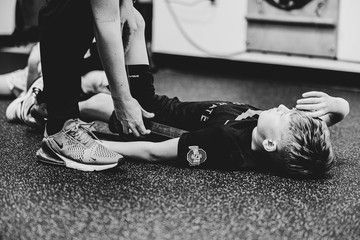
Athletes with restricted hip flexion or extension often land more upright, reducing their ability to absorb force through the hips. This shifts load toward the knee, particularly during repeated jump‑landing cycles.
Ankle Dorsiflexion
Restricted ankle dorsiflexion limits the tibia’s ability to move forward during squats, landings, and decelerations. The result is often:
Early heel rise
Increased forward knee travel
Higher patellar tendon loading
When these deficits coexist, the knee becomes the “path of least resistance” for force absorption.
Poor Landing Mechanics: Small Errors with Big Consequences

Common landing patterns seen in basketball players with anterior knee pain include:
Stiff landings with limited knee and hip flexion
Excessive knee valgus (inward collapse)
Asymmetrical loading between limbs
Minimal use of the posterior chain
Importantly, these same mechanics are repeatedly identified in prospective studies on ACL and patellar tendon injuries. Anterior knee pain is often the first warning sign before a more significant injury occurs.
Why Load Matters and what the LOAD of your AAU basketball player really looks like.
To understand why anterior knee pain is so prevalent, it helps to see what modern basketball load actually looks like, particularly in tournament‑style play, such as AAU circuits, which many young athletes participate in alongside school seasons.
At the professional level:
Load is adjusted daily
Recovery is actively managed
Movement quality is reinforced continuously
At the youth level, athletes often face:
High competition volume
Year‑round play with additional team/sport demands
Minimal movement or recovery guidance
That gap is where anterior knee pain, and later serious injury, often emerges.
What the Research Shows About Basketball Load
High‑minute youth basketball players can accumulate 9,000–13,000+ units of external load per month, with sharp weekly spikes during tournament play
Individual tournament weeks have been shown to reach ~5,000 units of load, concentrated over a few days
Basketball players commonly perform 40–70 high‑intensity jumps per game, with guards and wings often exceeding these numbers
Accelerations, decelerations, and braking actions occur hundreds of times per game, placing additional stress on the knee extensor mechanism
The key issue is not that these loads exist. The problem arises when:
Load increases rapidly
Recovery is insufficient
Strength and movement quality lag behind exposure
This is especially important for young athletes without consistent professional guidance, where skill work and competition volume often increase faster than physical preparation.
Overtraining Isn’t Always Obvious
Many athletes with anterior knee pain are not “doing too much” in a traditional sense, they are doing too much high‑intensity work without enough capacity or recovery.
Warning signs frequently include:
Pain that decreases once warmed up but returns afterward
Morning stiffness at the front of the knee
Declining jump or landing quality as games progress
Pain appearing late in tournaments or seasons
Research on youth and adolescent basketball players shows that sudden changes in weekly jump or movement load, rather than absolute volume alone, are closely associated with patellar and Achilles tendinopathy development.
Why Rest Alone Rarely Solves the Problem
Short periods of rest may reduce symptoms, but they do not address:
Posterior chain weakness
Faulty landing mechanics
Mobility restrictions
Poor load progression
Without intervention, athletes typically return to the same movement patterns and the same pain.
The Bigger Picture: Pain as a Prediction Tool
From a performance and injury‑prevention standpoint, anterior knee pain should be viewed as a system‑level signal, not just a local irritation. It often indicates:
Inefficient force absorption
Load exceeding current tissue tolerance
Increased risk for future knee injury
Addressing these factors early allows athletes to:
Improve performance
Reduce chronic pain risk
Lower the likelihood of major knee injury later
Final Thoughts
One of the most overlooked, but most powerful tools in injury prevention and long‑term performance is intentional rest, followed by intentional training.

Build in True Deload Periods Between Seasons
Between competitive seasons, athletes should have at least 5–7 consecutive days of active rest. This is not total inactivity, but a deliberate reduction in:
Jump volume
High‑intensity sprinting and change‑of‑direction
Organized games and structured practices
Active rest gives tendons, joints, and the nervous system time to decompress from cumulative load, reset sensitivity, and restore recovery capacity. Without these short deloads, athletes often carry hidden fatigue into the next season, setting the stage for chronic knee pain that appears “out of nowhere.”
Manage Load During Busy Seasons, Especially When Playing on Multiple Teams
Many basketball athletes now play on two or even three teams simultaneously (school, AAU, training leagues, showcases). While each environment may feel manageable on its own, the body does not separate loads by jersey color.
Key considerations for families:
Games and practices stack, not cancel each other out
Tournament weeks often create unintentional overload spikes
The athlete rarely gets a true “easy week”
When multiple teams are involved, someone must take responsibility for the global picture, tracking total games, practices, and intensity so recovery is not silently erased.
Use the Summer to Actually Train, Not Just Play
Summer should not function as “more season.” It is often the best opportunity to lower competition load and raise training quality.
Working with a qualified sports medicine or sports performance professionals during this window allows athletes to:
Clean up inefficient movement patterns
Improve landing and deceleration mechanics
Address posterior chain strength deficits
Build the capacity to better absorb future basketball loads
These changes dramatically reduce stress on the knee, but only if they are given space to develop.
Training Is What Maintains Protection
Movement quality, strength, and tissue resilience are not permanent. They must be reinforced.
This means making time during and between seasons to:
Maintain strength work
Revisit landing and jumping mechanics
Adjust loads as the athlete grows, matures, and plays more
Players who only “play” and never intentionally train often lose the very qualities that once protected them, even if they remain skilled on the court. They also fall behind in the physical attributes that often set athletes apart, fast, powerful, durable.
The Big Picture
Anterior knee pain is not a weakness, a flaw, or bad luck. It is often the body asking for:
Smarter spacing of load
Short, planned rest periods
Better preparation before intense competition
Ongoing support for movement quality and recovery
When families respect these principles, athletes are far more likely to stay healthy, play longer, and perform better,
not just this season, but for years to come.


Comments