
Building Speed, Agility, and Athletic Confidence in Pittsburgh’s Youth Athletes: A Progressive Guide by Earn the Edge Performance


If you’re a parent or coach in the Pittsburgh area, you already know how competitive youth sports have become—from soccer and baseball to football, track, lacrosse, and beyond. The athletes who stand out aren’t just naturally gifted—they’re the ones who learn proper movement, coordination, speed mechanics, and balance at a young age.
Research consistently shows that ages 7–9 are a safe and ideal time to begin structured speed and movement training, especially when the focus is on technique, neuromuscular
At Earn the Edge Performance, we specialize in developing young athletes the right way—by teaching the movement patterns, posture, and skills that translate to real‑game speed, long‑term durability, and a confident athletic foundation.
Why Early Speed Training Matters
Children experience rapid neuromuscular development during late childhood, creating a key window for learning foundational athletic skills. Long‑term athlete development research confirms that youth athletes benefit significantly from early exposure to coordinated movement and technical training—without the risks associated with high‑load strength programs. [researchgate.net]
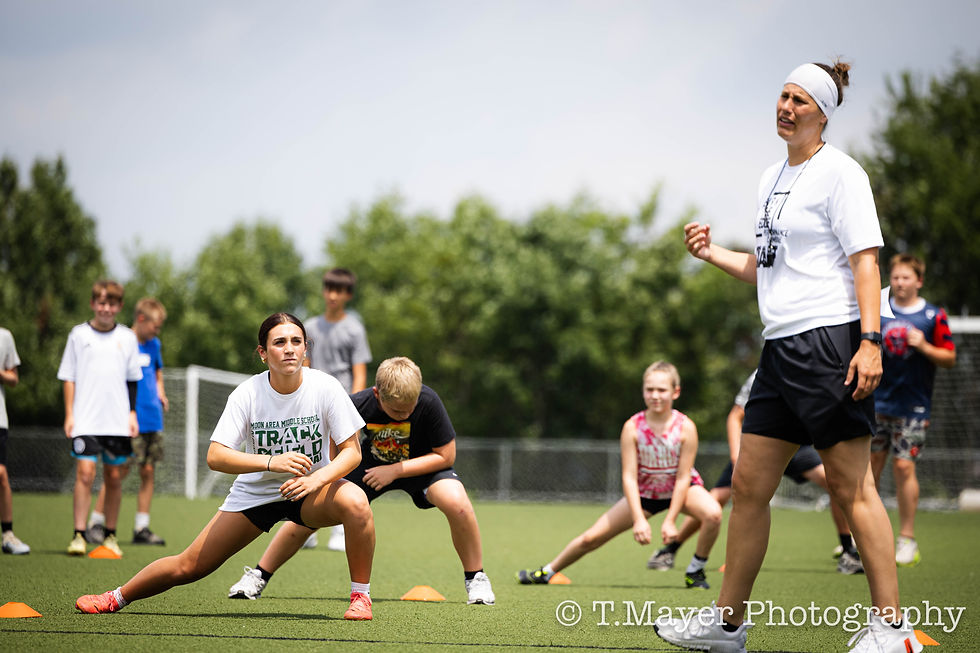
These early experiences improve:
Sprint mechanics
Multi‑directional agility
Body awareness
Balance and coordination
Injury resilience [frontiersin.org]
Starting early doesn’t mean “training hard”—it means teaching correctly.
1. Fundamental Foundations: Core Stability, Hip Strength & Balance
Before an athlete can run fast, they must be able to control their body in single‑leg stance—the root of all sprinting. Running requires significantly more balance, strength, and joint range of motion than walking, especially during the stance‑phase absorption and propulsion cycles. [physio-pedia.com]

A critical benchmark:
If your athlete cannot stand on one leg with the opposite knee lifted and maintain posture, they are not ready to develop elite‑level speed.
Experts in youth development stress that many athletes lack these foundational abilities, which limits their ability to express true speed safely. [simplifaster.com]
At Earn the Edge Performance, we teach:
Single‑leg stability
Glute activation
Core bracing and alignment
Marching, skipping, and bounding mechanics
These ensure young athletes can support, absorb, and generate force efficiently making speed development safer and more effective.
2. Running Posture: The Blueprint of True Speed

Sprinting is a skill. And like any skill, it must be taught progressively. Sprint experts emphasize that posture, limb alignment, and rhythm should be a priority from early stages. [coachathle...ics.com.au]
We train youth athletes to master:
Slight forward lean from the ankles
Tall torso and neutral spine
High, strong knee drive
Hips directly underneath the body
Balanced, fluid arm action
These foundational mechanics build efficient front‑side running—an essential component of generating speed and maintaining durability during peak performance years.
3. Foot Strike: Avoid Heel Striking and Tiptoe Running
Foot strike has a significant impact on performance and injury risk. Meta‑analysis research shows that rearfoot (heel) striking increases vertical loading rates, while extreme forefoot striking overloads the ankle and calf complex. [jospt.org]
Studies in young children also show that foot strike evolves naturally with age and is shaped by neuromuscular development and footwear. [researchgate.net]

We don’t “force” a foot strike. Instead, we build the posture and mechanics that allow a natural, efficient midfoot strike to emerge through:
Proper knee drive
Correct torso alignment
Strong hip and core stability
When mechanics are taught well, foot strike falls into place naturally.
4. Agility Development: Where Speed Meets Sport
Agility: reacting, decelerating, redirecting, and reaccelerating is essential in all Pittsburgh youth sports. A systematic review confirms agility is trainable in youth and improves through both neuromuscular development and perceptual‑cognitive training. [frontiersin.org]

For younger athletes, the best agility training includes:
Fun change‑of‑direction games
Reaction‑based drills
Balance and coordination work
Foundational speed mechanics
As athletes mature, we layer in:
Higher‑intensity deceleration
Advanced footwork
Game‑specific agility patterns
This progressive approach builds athletes who move confidently and decisively during competition.
5. Best Practices for Youth Speed Training (Backed by Research)
✔ Technique > Intensity
Children must learn correct mechanics before they try to run fast. [nextlevela...icsusa.com]
✔ Bodyweight First
✔ Keep It Fun
Games and engaging drills build consistency—key for long‑term development. [nextlevela...icsusa.com]
✔ Follow Age‑Appropriate Strength & Conditioning Guidelines
Scientific youth S&C frameworks emphasize tailoring training to biological age and maturation. [nysi.org.sg]
6. Why Consistency Creates Fast, Durable Athletes
Long‑term sprint development research demonstrates that early technical skill acquisition creates long‑lasting advantages in speed, coordination, and injury resilience. Technical fluency built early allows athletes to layer advanced mechanics in adolescence with far greater success. [coachathle...ics.com.au]
Consistent, well‑designed training helps Pittsburgh youth athletes:
Run faster
Cut and change direction more efficiently
Stay healthier throughout their seasons
Build confidence
Achieve higher athletic ceilings
Durability is the competitive edge.
Pittsburgh Parents: Give Your Athlete the Edge This Spring Break
🌟 Spring Break Speed & Agility Camp (Ages 7–14)
Hosted by Earn the Edge Performance
📅 April 1, 2026
⏰ 1:30–3:30 PM
📍 Peterswood Park – Soccer Field #5
🎯 Speed, Agility, Balance, Coordination, Footwork, and Running Mechanics

This camp is designed to teach the exact principles outlined in this article, powered by research, delivered with expert coaching, and built specifically for young athletes in the South Hills and greater Pittsburgh area.
Your child will learn:
Proper running form
Knee drive and hip mechanics
Foot strike education
Change‑of‑direction skills
Acceleration and deceleration
Balance and coordination drills
Fun, competitive challenges that build confidence
Perfect for:
Soccer
Football
Baseball/Softball
Lacrosse
Track & Field
Basketball
Multisport athletes
Spots will fill quickly, early registration recommended.
Final Takeaway: Speed Can Be Taught. Confidence Can Be Built. Durability Can Be Developed.
At Earn the Edge Performance, we believe in developing youth athletes the right way through research‑driven, movement‑first coaching that builds strong, confident, fast, and durable competitors.
Starting early (ages 7–9) gives Pittsburgh athletes a massive advantage when it matters most: middle school, high school, and beyond.
If you're ready to help your child build the skills that last a lifetime, we’re here to guide the journey.


Comments