
Week 3: Strength That Transfers — Not Just Lifts That Look Good
- Laura Baden
- Oct 27, 2025
- 5 min read

Train Like an Athlete Series | Earn the Edge Performance
When most athletes say they want to “get stronger,” they’re usually thinking about lifting more weight.
And that’s not wrong, strength is a foundational quality for performance.
But at Earn the Edge, we take it one step further. Because lifting heavy in the gym doesn’t automatically make you a better athlete.
The key is learning how to transfer that strength, to turn it into movement, speed, control, and resilience on the field or court.
That’s what separates athletes who are weight room strong from those who are game-time strong.
🧠 Understanding Strength That Transfers
Absolute strength refers to how much force your body can produce under ideal, controlled conditions, like a perfectly set-up squat or deadlift.
That’s the foundation "your engine."
But in sports, you rarely have the luxury of “perfect conditions.” Your feet slip. You change direction mid-sprint. You absorb contact. You land off-balance.
So the question becomes:
👉 Can you use that strength quickly, dynamically, and safely when the game gets chaotic?
That’s what we call transfer of strength, applying what’s built in the weight room to the unpredictable nature of sport.
⚙️ The Strength Transfer Equation
Absolute Strength + Speed + Coordination = Applied Strength
To perform well, an athlete needs all three pieces working together.
You can have massive strength, but if you can’t coordinate it at high speed, you’ll move stiffly or lose control. You can have great coordination, but if you lack strength, you’ll get overpowered in contact or lose explosiveness.
Transferable strength is about bridging the gap between power and performance, learning to express strength through movement.
🏋️♀️ Bodybuilding Strength vs. Athletic Strength
There’s a big difference between training to look strong and training to move strong.
Bodybuilding focuses on isolated muscles, symmetry, and appearance. Think: bicep curls, machine controlled lifts, and leg press.
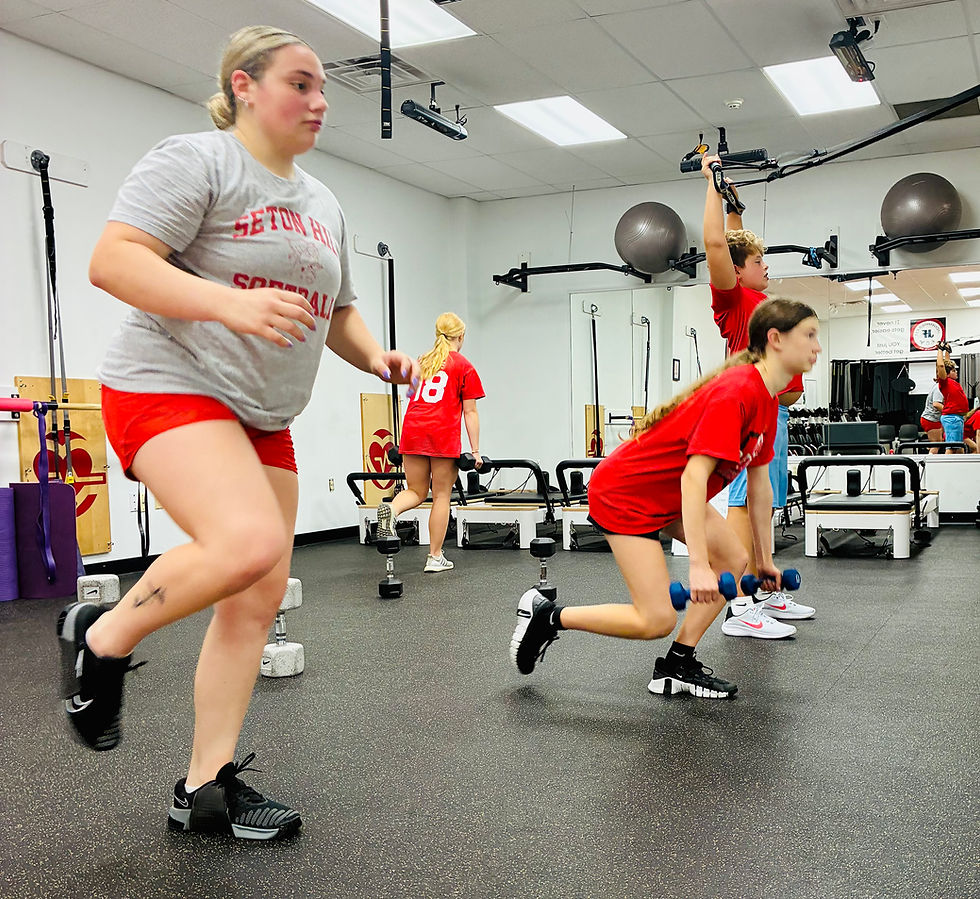
Athletic performance training focuses on coordinated movement patterns that reflect what happens in sport. Think: lunges, jumps, sprints, throws, and multi-directional force.
Both have value, but the goals are completely different.
A bodybuilder might have perfectly defined muscles, but that doesn’t mean they can cut, pivot, or absorb contact efficiently.
Meanwhile, an athlete needs to be able to produce and absorb force in multiple directions, under fatigue, and with precision.
🔍 Example: The 300 lb Squat That Doesn’t Translate
Let’s say two athletes can both squat 300 lbs.
Athlete A trains in a traditional strength program: heavy squats, presses, curls.
Athlete B trains for movement: single-leg squats, lateral hops, deceleration drills, med ball throws, and sprints.
In the weight room, they look the same. But on the field?
Athlete A might struggle to stop quickly when cutting, their muscles know how to push up heavy weight, not how to control speed. Athlete B can plant, absorb force, redirect, and explode out of a cut safely and efficiently.
That’s transferable strength.
🧩 What Strength That Transfers Looks Like in Training
At Earn the Edge, we design programs that help athletes turn raw strength into applied performance.
Here’s what that looks like in practice 👇
1️⃣ Multi-Planar Strength
Sports don’t happen in straight lines: athletes twist, pivot, rotate, and react. That’s why we train in all planes of motion:
Sagittal (forward/back) — sprints, squats, hinges
Frontal (side-to-side) — lateral lunges, shuffles
Transverse (rotational) — rotational med ball throws, pivots
➡️ Example: A volleyball player might perform rotational medicine ball throws to mimic how they create torque during a spike or serve.
2️⃣ Unilateral Loading

Most sports movements happen on one leg: sprinting, cutting, jumping, landing. Training one leg or arm at a time builds balance, stability, and corrects strength imbalances.
➡️ Example: A soccer player might perform rear-foot elevated split squats or single-leg RDLs to improve stride balance and deceleration control.
3️⃣ Dynamic Strength Work
Explosive movement is what separates “strong” from “powerful.” We train athletes to generate force fast with:
Med ball slams and throws
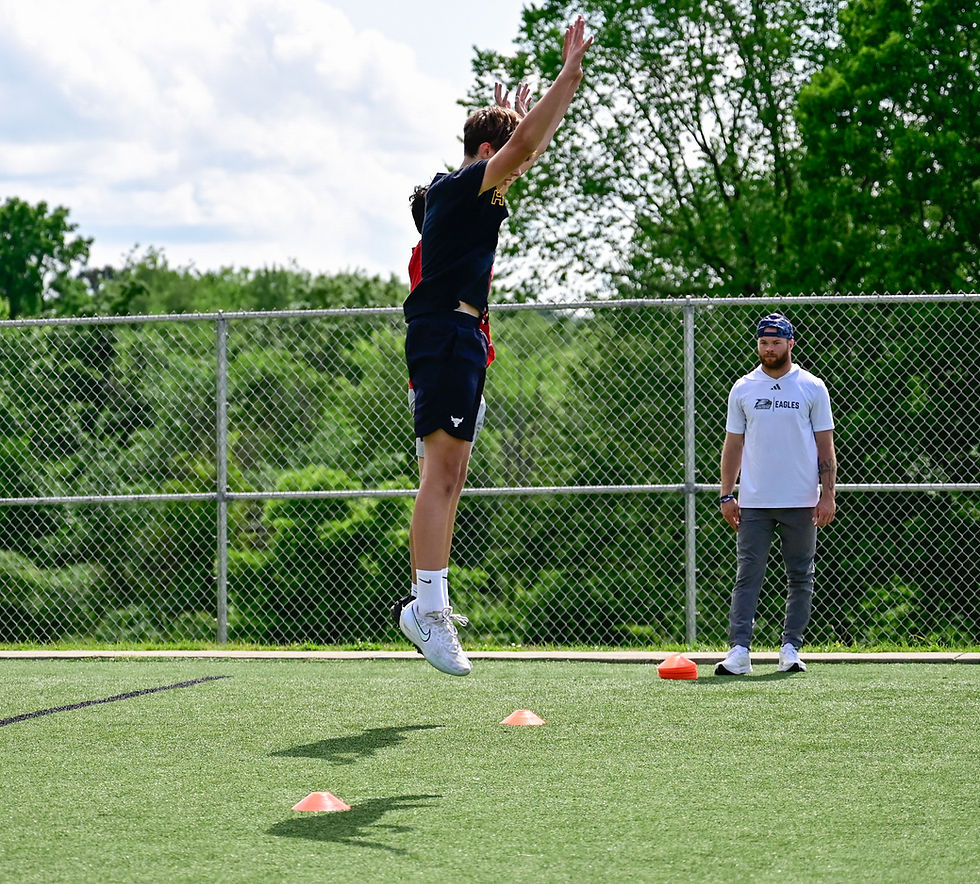
Jump progressions
Resisted sprints
Olympic lift derivatives (like high pulls or jump shrugs)
➡️ Example: A basketball guard performing loaded jump squats learns to produce force rapidly — translating to quicker takeoffs and rebounds.
4️⃣ Eccentric Control
Eccentric strength: the ability to control force while muscles lengthen is crucial for

deceleration and injury prevention.
Injury often happens not from producing force, but from failing to absorb it.
➡️ Example: A wide receiver lands from a jump and immediately cuts — if they can’t control that landing, stress shifts to the knee, increasing ACL risk.
Petersen et al., Am J Sports Med, 2014Eccentric-focused training improves deceleration mechanics and significantly reduces ACL injury risk.
At Earn the Edge, we build eccentric control through tempo squats, Nordic hamstring curls, and controlled landing drills.
5️⃣ Reactive Strength
Reactive strength is your ability to switch from absorbing force to producing it fast. It’s what makes you springy, agile, and explosive.
➡️ Example: Think of a volleyball player rebounding after a block or a baseball infielder reacting to a bad hop.
We train this using plyometrics, drop jumps, and quick change-of-direction drills that teach athletes to control and reapply energy instantly.
📘 Supporting Research Snapshot
Suchomel et al., Sports Medicine (2018): Strength transfer depends on matching training speed, direction, and control demands to those of the sport.
Petersen et al., Am J Sports Med (2014): Eccentric training reduces ACL injury risk by improving deceleration and landing mechanics.
Cormie et al., J Strength Cond Res (2010): Combining maximal strength training with velocity-based exercises produces the greatest gains in power and sport transfer.
🧠 The Earn the Edge Difference
At Earn the Edge Performance, we don’t just chase numbers on the barbell. We chase performance that shows up on game day.

That’s why every training session blends:
🏃♀️ Movement skill work – learning efficient mechanics for running, jumping, and landing
🏋️ Variable loading – free weights, bands, med balls, and bodyweight
⚡ Real-world application – drills that mimic game chaos, reaction, and timing
Because in sport, your opponent doesn’t care how much you can lift they care how well you can move.
We build strong, coordinated, adaptable athletes who are ready for whatever the game throws at them.
💬 Parent Tip: What to Look for in a Strength Program
If your athlete’s workouts look like this:
🦵 Machines
💪 Isolated lifts like bicep curls, tricep extensions, etc...
📏 Reps focused on “the pump”

…they might be building aesthetic strength, not athletic strength.
Instead, look for programs that include:
✅ Movement in multiple directions
✅ Single-leg or unstable positions
✅ Tempo or deceleration work
✅ Reactive and explosive drills
Ask this question:
“How does this lift help my athlete perform or stay healthy in their sport?”
At Earn the Edge, every exercise has a reason, to help your athlete move better, perform better, and stay injury-free.
🚀 Takeaway
Strength that transfers is the strength that matters. It’s what allows an athlete to:
Cut sharply without injury
Explode off the line
Maintain power late in the game
Move efficiently, confidently, and safely
We don’t just build muscle: we build better
athletes
📍 Coming Next: Week 4 — “Building Resilient Athletes”
We’ll dive into what durability really means, how to train recovery, and the science behind staying strong all season long.

Comments