
Why Your Young Athlete Isn't Jumping Higher And What Actually Works
- Laura Baden
- Jun 22
- 7 min read

By Laura Baden, LAT, ATC, OPE-C, CES, PES | Earn the Edge Performance | Pittsburgh, PA
If your athlete plays basketball, volleyball, soccer, or football, you've probably wondered: how do I help them reach their goals? Most parents invest in more travel teams, more showcases, and more skill work, but overlook the one thing that actually drives performance: physical development. Without it, athletes get overworked, underprepared, and more prone to injury. Here's what actually moves the needle and what we do differently at Earn the Edge Performance in the Pittsburgh area.
The Myth of "Just Play More"
This is one of the most common things I hear from parents: "She's at practice four nights a week, does additional skill sessions, and plays in tournaments every weekend... isn't that enough?"
It's a fair assumption. More reps equals more improvement, right? Not exactly.
Sport-specific practice develops sport-specific skills: court awareness, game IQ, positioning, timing. Those things matter. But sport practice is not the same as athletic development. Playing basketball does not systematically train the neuromuscular qualities (eccentric strength, rate of force development, reactive stiffness) that are the actual physiological drivers of a higher vertical jump.
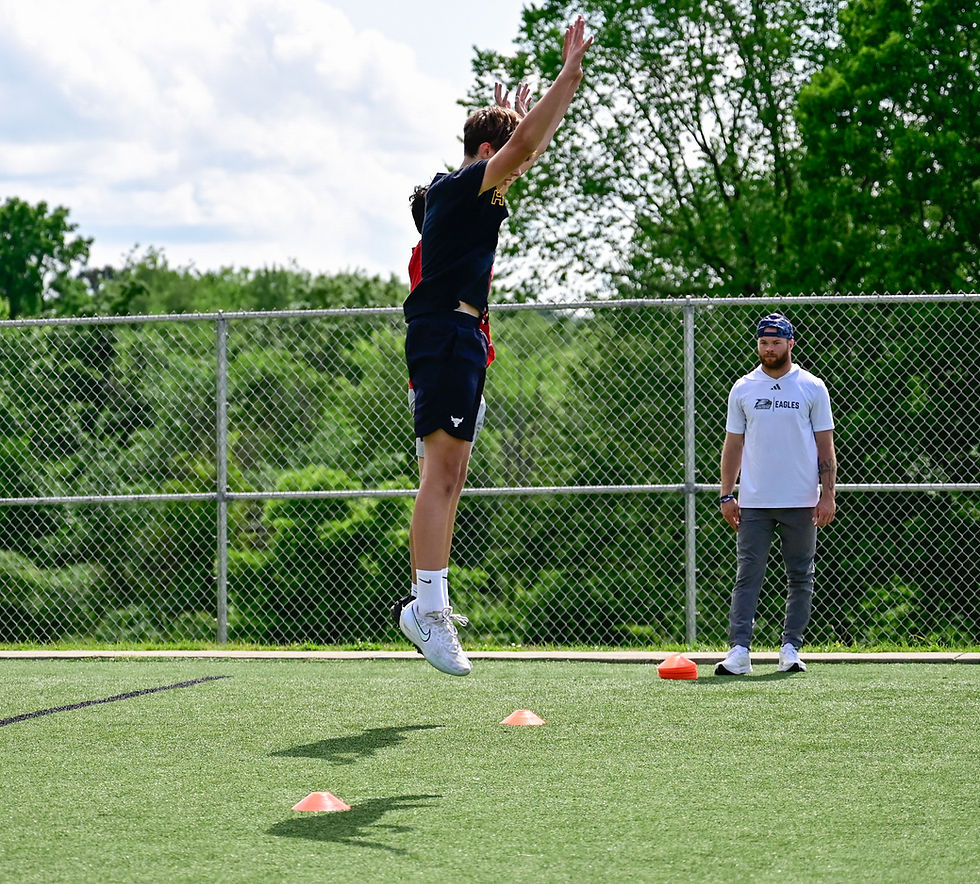
In fact, high-volume sport practice without targeted physical preparation can work against your athlete. Repetitive jumping and landing under fatigue, without proper strength base or movement quality, is one of the leading contributors to overuse injury in adolescent athletes. We see it constantly: patellar tendinopathy, Sever's disease, Osgood-Schlatter, and — most concerningly — ACL tears in young female athletes who never developed the strength and mechanics to protect their own knees.
Playing your sport is necessary. It is not sufficient. And it will not maximize your jump.
What Vertical Jump Actually Is (Most People Get This Wrong)
Before we talk about how to develop it, let's be precise about what a vertical jump is biomechanically.
A vertical jump is a ballistic, whole-body power expression that requires:
Eccentric force absorption — loading the hip, knee, and ankle under rapid deceleration
Elastic energy storage — the stretch-shortening cycle (SSC) taking mechanical advantage of the muscle-tendon unit
Concentric force production — explosive triple extension of hip, knee, and ankle
Rate of force development (RFD) — how fast the neuromuscular system can produce that force within the ground contact window (often less than 250 milliseconds)

This is not a "leg strength" problem. A squat 1-rep max does not reliably predict vertical jump. Athletes who are strong in slow, controlled movements often fail to transfer that strength into fast, explosive ones because the ability to express force quickly is a distinct quality that must be trained separately.
The Role of Eccentric Training: The Most Undervalued Tool in Youth Development
Eccentric training, the controlled lengthening of a muscle under load, is foundational to jump development, and it is consistently undertrained in youth sport programs.
Here's why it matters so much:
1. Eccentric Strength Is the Foundation of Reactive Power
The stretch-shortening cycle (SSC) is what allows elite jumpers to load and explode with remarkable efficiency. The eccentric (loading) phase of a jump, the countermovement, pre-loads the musculotendinous unit, storing elastic energy that is released in the subsequent concentric push-off.
If your athlete cannot control the eccentric phase, they cannot efficiently use it. A weak

eccentric means energy is dissipated (wasted) rather than stored and returned. You can see this in young athletes who sink into a deep, slow squat before jumping, they're losing elastic energy rather than utilizing it.
2. Eccentric Deficits Are a Primary ACL and Patellar Tendon Risk Factor
Research is consistent here: eccentric quadriceps and hamstring weakness, especially under high-speed, high-load conditions, is one of the strongest modifiable risk factors for lower extremity injury in young athletes. Young female athletes are at 2–8x greater ACL injury risk than males in comparable sports, and a significant portion of that risk is trainable.
At Earn the Edge Performance, we screen for eccentric deficits as part of athlete evaluation. An athlete who cannot decelerate efficiently is not only leaving performance on the table, they are a higher injury risk every time they step on the court or field.
3. Eccentric Training Improves Tendon Stiffness
Tendons adapt more slowly than muscle. Eccentric loading, slow, controlled lengthening under tension, is the primary stimulus for tendon remodeling and stiffness development. Stiffer tendons are more efficient at energy return. This is one of the primary reasons plyometric performance improves with a structured eccentric training phase.
Practical application: Nordic hamstring curls, single-leg Romanian deadlifts, slow eccentric squats (3–5 second lowering phase), and loaded step-downs are not glamorous exercises. But they are cornerstones of evidence-based vertical jump development and injury prevention in the athletes I work with.
Jumping and Landing Mechanics: The Foundation You Can't Skip
You cannot train power on a broken foundation. Before adding load, volume, or intensity to any jump training program, an athlete must demonstrate competent jumping and landing mechanics.

What Good Mechanics Look Like
Take-off:
Triple extension: full extension at the hip, knee, and ankle simultaneously
Arm drive coordinated with leg drive
Minimal inward collapse of the knee (valgus) during the push-off phase
Foot in full contact with the ground through the power phase
Landing:
Soft, "quiet" landing, absorbing force through a triple-flexion pattern (hip, knee, ankle)
Knees tracking over the second toe, not caving inward
Hip hinge dominant, the hip should be the primary absorber, not the knee
Balanced, controlled base of support no excessive forward trunk lean, no single-leg wobble
The Problem With Young Athletes
Adolescent athletes, especially those in rapid growth phases, commonly exhibit:
Knee valgus collapse on landing: the knees cave inward upon ground contact. This is a primary mechanism of ACL injury and is far more common in female athletes.
Stiff-knee landing: landing with minimal knee bend, transferring ground reaction force directly into the joint rather than absorbing it through the musculature.
Overextended trunk: landing with excessive forward lean, reducing gluteal contribution and overloading the anterior knee.
Bilateral asymmetry: favoring one leg during landing, which both signals and reinforces underlying strength deficits.
None of these are corrected by playing more basketball, soccer, lacrosse, volleyball. They require deliberate, cued, progressive training with an expert who can identify and correct the pattern before it becomes an ingrained habit, or an injury.
How We Actually Develop Power at Earn the Edge Performance
Power = Force × Velocity. To increase vertical jump, we must develop the ability to produce high force in a very short time window. This requires a phased, progressive approach.
Phase 1: Movement Quality and Eccentric Foundation
Before any athlete begins jump training under our care, they demonstrate:

Competent bilateral and unilateral squat mechanics
Controlled landing from a box step-down
Adequate hip hinge pattern
Baseline eccentric strength
This phase builds the tissue capacity and neuromuscular control to safely handle progressively higher demands. Skipping this phase is how young athletes get hurt.
Phase 2: Strength Development
A meaningful strength base is required before reactive/plyometric training produces the results parents are hoping for. We use relative strength thresholds, not absolute load, as gate criteria for progression. Your athlete does not need to powerlifting-compete. But they do need sufficient force production capacity before plyometric work can be optimized.
Key movements: goblet squat, trap bar deadlift, Bulgarian split squat, Romanian deadlift, hip thrust.
Phase 3: Reactive and Plyometric Training, Building the Spring
This is where the fun happens. Plyometric training, when introduced at the right time, with the right mechanics, at the right volume, is the most effective modality for vertical jump development in young athletes.
We progress through:
Low-intensity plyometrics: Box jumps with controlled landing, broad jumps, vertical jump practice with cueing
Moderate intensity: Depth drops → depth jumps, single-leg hops and bounds
High intensity: Repeated reactive jumps, approach jumps, sport-specific power expression
Throughout, we're monitoring ground contact time, jump height (when measurable), and mechanics under fatigue.
Phase 4: Transfer Training
Power developed in the weight room must transfer to the court or field. This phase integrates sport-specific movement patterns with the power qualities built in earlier phases — approach jumps, reactive movements, competition-specific context.
What Parents Should Look For in a Youth Performance Program
Not all training is created equal. If your child is in a program that:
Has them doing the same workout as adult athletes
Never assesses movement quality or injury history
Focuses exclusively on "burning them out" with conditioning
Never teaches landing mechanics
Adds load before competence
...that is not sports performance training. That is occupying time.
At Earn the Edge Performance, Elite Sports Performance program, every athlete begins with a movement screen. Programming is periodized, meaning it has a logical phase structure that builds capacity over time, not random daily variation. We integrate sports medicine expertise directly into performance programming, which means we are not just chasing numbers. We are developing whole athletes who are more capable and more resilient.
We work with youth athletes in the Pittsburgh South Hills area from beginners who are new to structured training to competitive high school athletes preparing for the next level.
The Bottom Line
If you want your athlete to jump higher, here is the honest hierarchy:
Mechanics first — fix what's broken before adding intensity
Eccentric strength — develop the ability to control force before demanding the ability to produce it
Progressive strength training — build the base that makes plyometrics effective
Plyometric training — train the specific quality of reactive power
Transfer — connect everything back to the sport
Playing more does not systematically address any of these. It can complement them. It cannot replace them.
The athletes we work with at Earn the Edge Performance don't just jump higher. They land safer, run faster, and compete more confidently because the training addresses the underlying athletic qualities, not just the symptom.
Ready to Start?
If your athlete is in the Pittsburgh area — Venetia, Upper St. Clair, South Fayette, South Park, Bethel Park, Peters Township, Canon-McMillan, or surrounding communities — and you want training that is actually built on sports science, reach out to us at Earn the Edge Performance.
Our programs are designed for athletes who are serious about development
not just getting sweaty.
📍 Earn the Edge Performance | Pittsburgh South Hills, PA📧 Connect with us to schedule an athlete evaluation.


Comments